Impact of the U.S. Government Shutdown on the Indian Financial Market (2025)
Search for a command to run...
No comments yet. Be the first to comment.
The Cambridge Dictionary defines slavery as “the activity of legally owning other people who are forced to work for or obey you.” However, capitalism has stealthily redefined slavery. When we think of slavery, we often imagine chains or cages around ...
Introduction Money is the vital blood that circulates life through the economy, while gold is the immutable skeleton providing its underlying structure and stability. When everything in the financial market was deteriorating, the corroding, shining...
Rishav Bhalotia
3 posts
As of October 1, 2025, the world’s largest economy — the United States, valued at nearly $30.5 trillion — has come to a standstill. The federal government has officially shut down, with no clear timeline for reopening.
The shutdown occurred because Republicans failed to secure the votes needed to pass the federal funding bill in Congress. Although they hold significant influence in both chambers, they fell short of the 60 votes required in the Senate. This gave Democrats leverage in negotiations over key budget priorities.
At the heart of the deadlock were disagreements over healthcare and social spending. Democrats opposed proposed cuts to Medicaid, health agency budgets, and expiring tax credits, arguing these would make healthcare unaffordable for many Americans. Republicans, on the other hand, are trying to cut down on spending to control the rising fiscal deficit. As both sides failed to compromise, the funding bill failed to pass, which caused a government shutdown.
The U.S government has not faced a shutdown since December 22, 2018 – January 25, 2019(35 days) longest in American history.
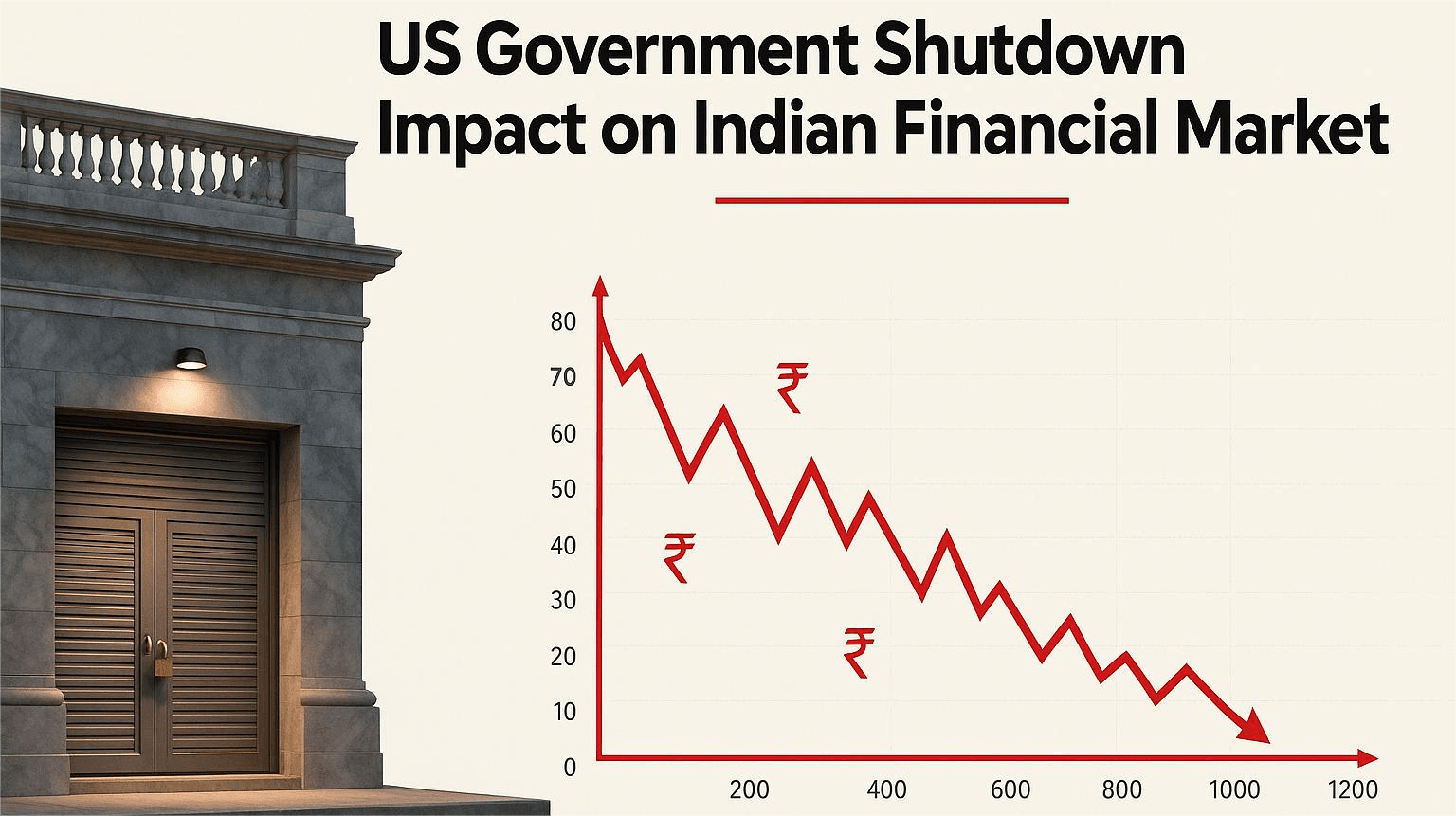
The U.S. is the financial capital of the world, and disruptions in its economy quickly ripple across developing nations like India. The current shutdown has triggered market uncertainty, capital flight, and slower investment inflows, affecting multiple sectors:
Due to capital flight Indian rupees are losing value against the U.S dollar. On the other hand, government bond yields are rising, so investors are channeling their money into bonds seeking safer options during the time of crisis.
The Contraction of Foreign Institutional Investors (FIIs) and Foreign Portfolio Investors (FPIs) has caused sharp volatility in the Indian equities market. However, RBI is able to manage the fluctuation in the market that is caused by the American policies change.
Since the U.S. is a major client for India’s IT and outsourcing sector, project delays and deferred contracts are likely, which could hurt employment and export earnings.
Indian startups relying on foreign venture capital and private equity are facing a slowdown in funding, as global investors turn cautious amid uncertainty in the U.S. market.
A drop in U.S. consumer spending — as many federal workers go unpaid — has weakened demand for Indian exports such as textiles, chemicals, gems, and engineering goods.
Uncertainty in U.S. demand, possible tariff adjustments, and delayed orders have increased costs and disrupted production for Indian manufacturers and pharmaceutical firms.
Furloughs in U.S. federal agencies like the FAA (Federal Aviation Administration) could slow down air travel logistics, indirectly affecting Indian airlines and tourism connected to the U.S. market.
The American shutdown has once again proven that in today’s globalized economy, no nation operates in isolation. The U.S. financial system acts as a backbone for international trade, capital movement, and investor confidence. As the saying goes, “When America catches a cold, the world feels the fever.” The current crisis highlights how vital the stability of the U.S. economy is for sustaining growth in emerging markets like India.