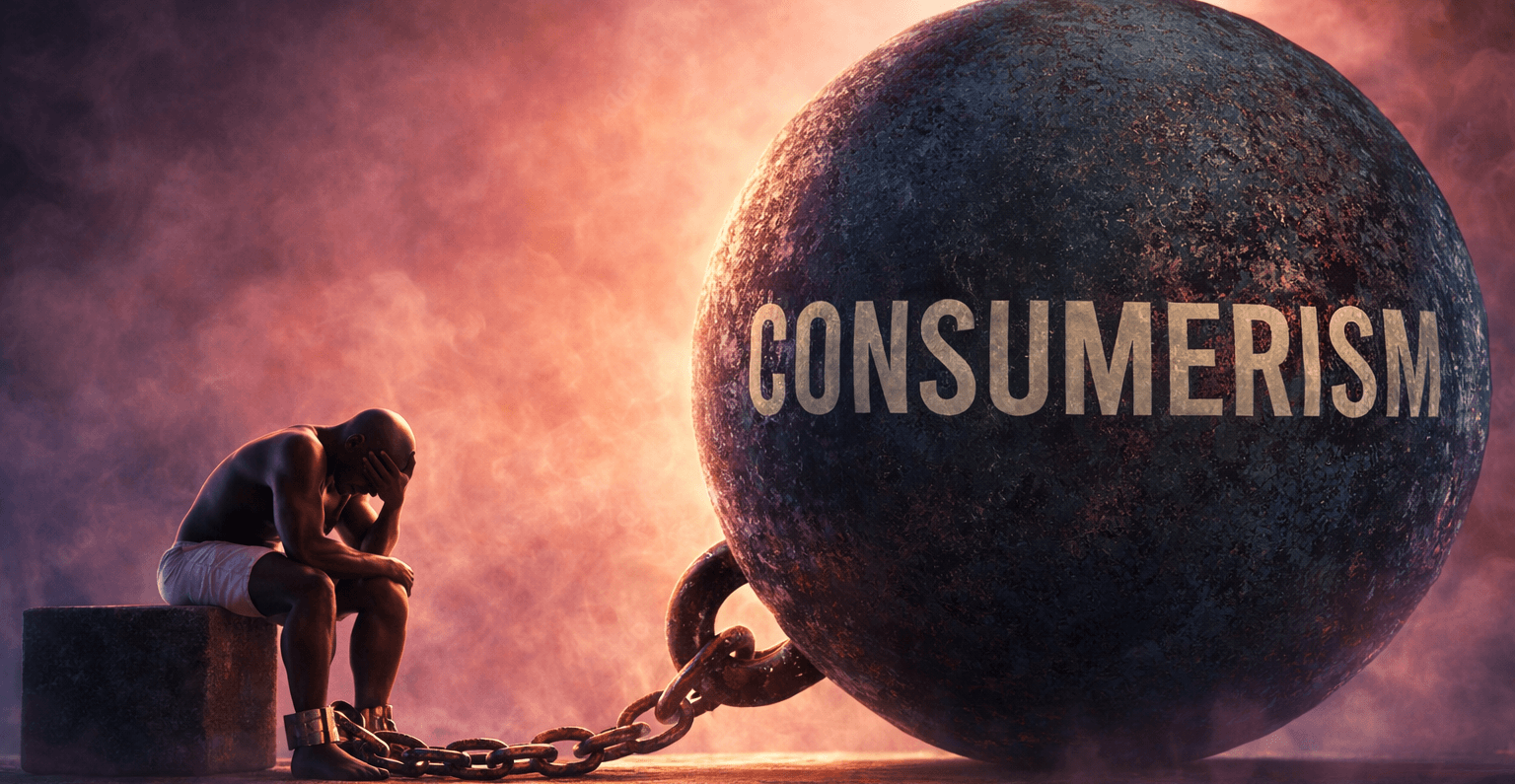
Consumerism is fancy and modern word for slavery
Search for a command to run...
No comments yet. Be the first to comment.
Introduction Money is the vital blood that circulates life through the economy, while gold is the immutable skeleton providing its underlying structure and stability. When everything in the financial market was deteriorating, the corroding, shining...
As of October 1, 2025, the world’s largest economy — the United States, valued at nearly $30.5 trillion — has come to a standstill. The federal government has officially shut down, with no clear timeline for reopening. Why the U.S. Government Shut Do...
Rishav Bhalotia
3 posts
The Cambridge Dictionary defines slavery as “the activity of legally owning other people who are forced to work for or obey you.”
However, capitalism has stealthily redefined slavery. When we think of slavery, we often imagine chains or cages around an individual as a visible form of control. But what if you love your chains, or tie your identity to your cage? What would you do then? You would protect it.
The worst part is that you wouldn’t even realise it. You begin to believe it is your own choice and continue following and repeating the same patterns. The reality, known only to a few or the so called elite is that many of the choices we make are not truly ours. They are implanted in our consciousness through advertisements and media.
In short, the new word for slavery in the capitalist era is consumerism. The problem is that this shift in meaning largely goes unnoticed today. Unlike historical slavery, consumerism operates far less overtly. It does not bind bodies; it shapes desires. It does not demand obedience; it encourages participation.
In this sense, consumerism can be understood as the idealization of slavery a form of domination that no longer requires coercion but is sustained through consent. The modern world is no longer structured around visible chains or direct control. Instead, it constructs systems in which personal desires and aspirations are guided by powerful economic and cultural institutions rather than by genuine free will.
When individuals are conditioned to love their chains, rebellion never begins.
Does it not seem as though history has always functioned this way? no. For nearly two decades after World War II, labour was regarded as the most important resource in the economy. This shift granted respect and power to the working class. Labour was often prioritised over abstract capital such as money or machinery, largely due to the strength of trade unions that organised and protected workers.
This system enabled affordable education, robust social welfare, and relatively low levels of personal debt. While it was not a perfect order in the post-war world, it was nevertheless stable and dignified. A significant portion of the working population lived without the constant fear of economic insecurity.
Around 1980, the economy was moving toward greater income equality, and this narrowing gap between working class and rich class proved intolerable to economic elites. The upper strata were unwilling to share economic and social space with the emerging middle classes. This resistance led to a reorganisation of the global economic order, brought about through a transformation of the political landscape most notably through the Reagan Revolution in the United States and Thatcherism in the United Kingdom
These changes were packaged in the language of free market capitalism and personal freedom, yet their underlying purpose was to place money and capital above human labour. Collective bargaining was weakened, trade unions lost their power, and welfare systems were steadily dismantled. This marked the erosion of a worker centred economic order and the adoption of a system designed to restore comfort and dominance to those holding economic power.
Individuals were no longer primarily regarded as workers but were redefined as consumers. Income inequality widened, and economic insecurity became a constant feature of everyday life. The central objective of this transformation was to shift society’s mindset from that of the worker to that of the consumer
Where the consumer gives off the sense of freedom and privilege. But it's the other way around, it causes dignity and purposelessness, economic dependence, insecurity, and nervousness. Debt turns into a new form of slavery, the illusion of choice, reduced collective power, people are stripped of the production process, social comparison contributes to a psychologically dismayed state of people.
Herbert Marcuse in “One-Dimensional Man” (1970), mentions that consumerism turns the false need into real need. He explained the difference between the false need and real need and through society and media influence false need gives the impression of true need, when this happens people purchase goods that they don't even need. The real needs are connected with survival, dignity, and freedom but the false needs are created by media and advertisements in order to continue the consumption.
In different writing but showing different conclusions to the same standpoint for consumerism is the work of Enrich Fromm in “To have or to be”, he exposes how people’s identity become to the things they own and not by being. It is based on what an individual has, such as status, lifestyle and visibility, not inventive thinking, self-reliance or valuable relationships. This change between the being state to the having state turns human beings into market objects and thus consumerism is more like slavery rather than freedom.
These both theories, are proving accurate in the current situation. Pushing people to live by society rather than their own will and media influence impulse purchase.
Gen Z earns more than their parents did at the same age (even in real terms) yet paradoxically carries the highest average personal debt of any generation before them. They often spend money they do not yet have, fueled by “buy now, pay later” schemes. At a very early stage of life, Gen Z has accumulated such significant debt that wealth creation feels more like a fairy tale than a realistic goal. On the other hand, previous generations focused more on building wealth. They delayed consumption, choosing to save first rather than spend immediately. This paradox exposes a deeper structural problem: modern consumerism functions as a perfected form of slavery one that does not rely on force, but on desire, debt, and self-discipline.
Slavery once relied on iron chains that could be seen and resisted; consumerism survives by hiding its chains in desire, debt, and choice. So-called cultural intermediaries content creators, artists, and public figures act as the bridge between consumers and cash-rich corporations, promoting goods and services that create desire rather than meet real needs. In an economy where money is considered the most important resource, manipulating becomes very easy. Repeated exposure creates a stimulus response mechanism in which consumption becomes habitual rather than rational. Goods are purchased not for their use-value, but for their symbolic value what they communicate about success, belonging, and status. Identity itself becomes performative.
The social media platforms seem to represent free zones of expression, interconnection, and freedom of choice. Nevertheless, the real purpose of their existence is to influence desire, behaviour and identity. In case consumerism is the epitome of slavery, the most effective weapon is social media.
If you are not paying, you are the product
Social media is free, as users themselves are a commodity. The platforms collect data tastes, habits, feelings and insecurities and sell them to advertisers. Citizens are turned into data generating individuals, the focus of which is sales. The domination becomes unseen, gratifying, and omnipresent.
The whole system seems to be working in their favour. People choose to consume, choose to borrow, and choose to participate. Yet these choices are structurally engineered. Advertising manufactures desire, platforms normalise excess, and financial systems monetise impatience. Control is internalised; individual’s police themselves working harder, consuming more, and sinking deeper into dependency.
One gets more miserable, the more choices anyone has. The endless choice seems empowering but that's not true, this creates the “paradox of choice”, this proves that the choices that we make to make ourselves happy and satisfied actually ends up making us more anxious, less satisfied and regret the decision. The paradox of choice makes us compulsive buyers; the endless choice makes our brain fear of making the wrong choices because something better could be out there. The paradox proves short satisfaction over the long term. The big corporations understand this very nature of the consumer, and that's how they keep us engaged in the consumption. Endless choice convinces the mind that identity lies in selection, the moment choices define who you are, you cease to be free and become enslaved.
Capitalism and political systems seek to keep individuals caged and occupied with false needs, allowing those at the top to maintain their dominance.
As Herbert Marcuse warned, false needs replace real ones. As Erich Fromm observed, identity shifts from being to having. In this condition, people do not revolt because they believe they are free. When chains are loved, resistance becomes unthinkable.
Consumerism, therefore, is not the opposite of slavery it is its most refined form. A system that does not need to coerce, because it convinces its subjects that obedience is desire, and captivity is choice